Electric Motorcycle Range: Why City and Highway Numbers Differ
Grounded Question
How far will an electric motorcycle actually go when you ride it the way you normally ride?
An electric motorcycle can have very different range depending on where and how you ride.
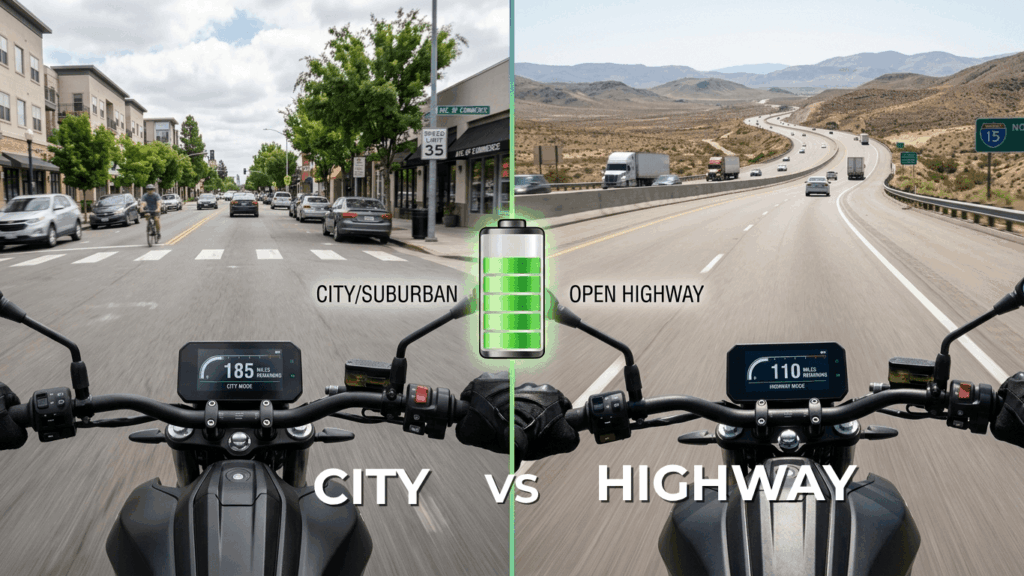
City riding, mixed roads, and sustained highway speeds don’t place the same demands on the battery. That’s why range testing itself separates urban riding from constant-speed highway operation.
The important question isn’t:
How much range does this motorcycle claim?
It’s:
Will its realistic range comfortably cover my normal rides?
At a Glance
| If you mostly ride… | What matters most |
|---|---|
| City streets | City range |
| Suburban and mixed roads | Combined range |
| Sustained highway speeds | Highway range and test speed |
| Long-distance routes | Range, charging speed, and charger availability |
Short Answer
City range and highway range are not interchangeable.
At higher speeds, an electric motorcycle uses more energy overcoming aerodynamic resistance. City riding involves lower average speeds and different operating conditions, which can produce a very different range result.
So before buying an electric motorcycle, don’t look only at its biggest advertised range number.
Look for the number that best matches how you actually ride.
Estimate Your Realistic Range
The Grounded Gear Electric Motorcycle Range Calculator helps you estimate range based on your riding conditions.
Adjust:
- City versus highway riding
- Temperature
- Riding style
- Wind
- Passenger or cargo load
It also uses an 85% usable-range buffer in its estimate to provide a more conservative planning result.
[Try the Electric Motorcycle Range Calculator →]
Why Highway Riding Changes Range
The simplest answer is speed.
As speed increases, aerodynamic resistance becomes a larger part of the energy required to keep the motorcycle moving.
That’s why electric motorcycle range testing distinguishes between city operation and constant-speed highway operation. The Motorcycle Industry Council’s range procedure includes separate constant-speed tests at 55 mph and 70 mph, illustrating why “highway range” isn’t necessarily one universal number.
A motorcycle’s range at 55 mph may not represent its range at 70 mph.
And neither number automatically represents how you ride.
Why City Range Can Look Better
City riding generally involves lower average speeds and less sustained high-speed operation.
The riding conditions are also different:
- Frequent acceleration
- Frequent deceleration
- Lower average speeds
- More opportunities for regenerative braking
Regenerative braking can recover some energy during deceleration, but it doesn’t eliminate the energy required to accelerate again.
The bigger point is simple:
City riding and sustained highway riding use energy differently.
That’s why a motorcycle can perform well for a local commute but feel much more limited on a long highway trip.
What Else Affects Range?
Speed is important, but it isn’t the only thing that changes range.
Temperature
Very cold or hot conditions can affect battery performance and energy use.
Wind
A headwind increases the air resistance the motorcycle has to overcome.
Riding Style
Hard acceleration and aggressive riding generally use more energy than smoother, moderate riding.
Passenger or Cargo
Additional weight can affect energy use, particularly during acceleration and climbing.
Terrain
Hills require additional energy going up. Regenerative braking may recover some energy on the way down, but not all of it.
These variables are why two riders can get different results from the same motorcycle.
How Much Range Do You Actually Need?
Don’t start with the motorcycle.
Start with your rides.
Ask yourself:
- How far is my normal commute?
- How much of it is city versus highway?
- What speed do I normally travel?
- How far is my typical weekend ride?
- Where can I charge?
- How much battery reserve am I comfortable keeping?
Now compare those answers with the motorcycle’s range information.
A motorcycle with less maximum range may be perfectly adequate for a rider with convenient charging and short daily trips.
A motorcycle with a large battery may still be a poor fit if your normal route involves long stretches of sustained highway riding without convenient charging.
Before You Buy
1. Find Out What the Range Number Represents
Is it city range, highway range, combined range, or a manufacturer estimate?
Don’t assume the largest number applies to every type of riding.
2. Check the Highway Test Speed
If a highway figure is available, find out the conditions behind it.
Range measured at one sustained speed may not match your normal cruising speed.
3. Test Your Normal Ride
Use the Electric Motorcycle Range Calculator to model the route and conditions you expect to encounter most often.
Then try less favorable conditions, such as:
- More highway riding
- Colder weather
- Wind
- Additional load
You don’t need to plan for the worst possible ride every day.
But if the motorcycle only works under ideal conditions, the range may be too tight.
4. Leave a Buffer
Don’t choose a motorcycle based on reaching your destination with nothing left.
A comfortable range buffer gives you room for detours, changing conditions, and charger problems.
The Grounded Gear calculator uses an 85% usable-range assumption for its estimate, but your own preferred buffer may be different.
Living With It
Electric motorcycle owners eventually learn what their motorcycle can do under different conditions.
A familiar commute may become easy to predict.
A fast highway route may require more attention.
A windy or cold day may change the plan.
The goal isn’t to constantly watch the battery percentage.
It’s to choose a motorcycle with enough range that your normal rides don’t require constant mental math.
Who Should Consider an Electric Motorcycle?
🟢 Buy
If your normal rides are comfortably within the motorcycle’s realistic range and you have convenient charging.
🟡 Depends
If the motorcycle works for most of your riding but longer or highway-heavy trips require planning.
🔴 Skip
If your typical rides regularly push the motorcycle’s realistic range or convenient charging isn’t available.
Grounded Verdict
Depends.
Electric motorcycle range isn’t a single number.
City riding, highway speeds, weather, riding style, wind, load, and terrain can all change the result.
For buyers, the most useful range figure is not necessarily the biggest one.
It’s the one closest to how you actually ride.
Before buying, compare your normal routes with realistic range expectations—and leave enough room that every ride doesn’t become a battery calculation.
Related Tool
Electric Motorcycle Range Calculator
Estimate your range based on city/highway riding, temperature, riding style, wind, and load.