PAS vs. Throttle: Which E-Bike Should You Buy?
Grounded Question
Do you want your e-bike to help you pedal—or do you want it to move you without pedaling?
That sounds like a simple question, but it changes the entire riding experience.
Pedal assist (PAS) makes an e-bike feel more like a bicycle with an electric tailwind. A throttle makes it feel more like a small electric scooter.
Neither is automatically better.
The right choice depends on how you plan to use the bike.
At a Glance
| If you… | Consider |
|---|---|
| Want to stay actively involved in riding | PAS |
| Want longer range from the same battery | PAS |
| Want a more natural cycling experience | Torque-sensor PAS |
| Want effortless starts from a stop | Throttle |
| Have limited mobility or difficulty starting from a stop | Throttle |
| Want help getting through intersections quickly | Throttle |
| Want maximum flexibility | PAS + Throttle |
Short Answer
For most riders who want an e-bike to still feel like a bicycle, pedal assist is the better starting point.
If convenience, accessibility, or effortless acceleration matters more than pedaling, a throttle can be extremely useful.
And if you want both experiences, an e-bike with PAS and a throttle may be the most versatile option.
But there’s an important detail many buyers miss:
Not all pedal assist feels the same.
A cadence sensor and a torque sensor can make two bikes with “pedal assist” feel completely different.
What Is Pedal Assist?
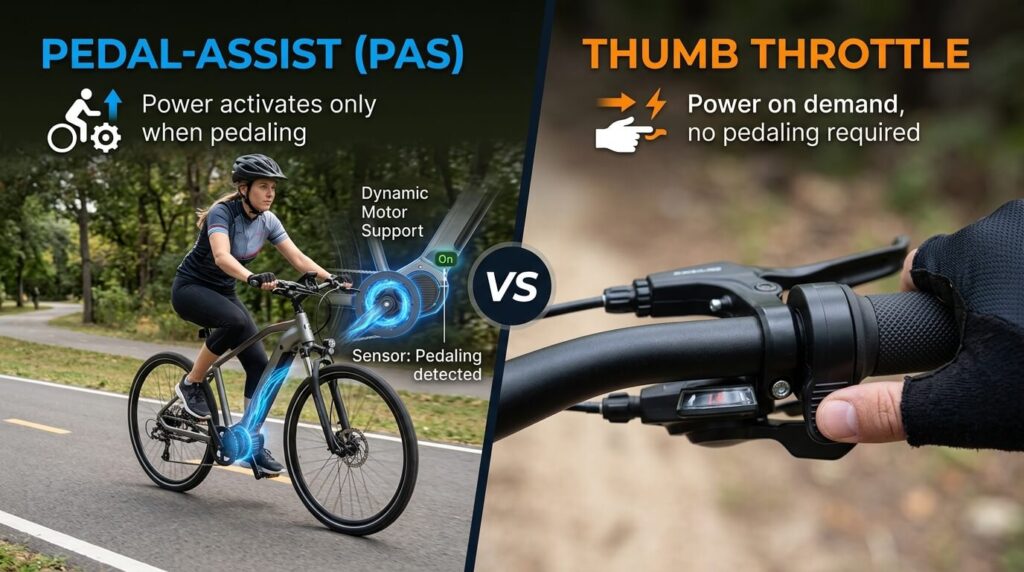
Pedal Assist, or PAS, activates the motor when you pedal.
The basic idea is simple: you provide the effort, and the motor adds assistance.
How that assistance feels depends heavily on the sensor.
Cadence Sensor
A cadence sensor mainly detects whether the pedals are turning.
Once you start pedaling, the motor provides assistance according to the selected level.
It’s relatively simple and cost-effective, but the power delivery can feel more like an on/off switch.
Torque Sensor
A torque sensor measures how much force you’re actually putting into the pedals.
Pedal harder and the motor responds with more assistance. Pedal lightly and it provides less.
The result is a more natural feeling ride where the motor feels like an extension of your own effort.
That’s an important distinction when shopping for an e-bike. “Pedal assist” alone doesn’t tell you how natural the bike will feel.
What Is a Throttle?
A throttle lets you activate the motor without pedaling.
Depending on the bike, it may be controlled by a thumb lever or twist grip.
The result is immediate motor power, including from a standstill.
That makes a throttle particularly useful when:
- Starting from a stop
- Climbing a steep hill
- Getting through an intersection
- Carrying additional weight
- You simply don’t feel like pedaling
The tradeoff is that you’re asking the motor to do more of the work.
PAS vs. Throttle: What Does It Actually Feel Like?
Here’s the simplest way to think about it:
PAS
“I’m riding a bicycle, and the motor is helping me.”
The brief describes this experience as a kind of “tailwind” sensation—your own effort is still central, but the motor makes the ride easier.
Throttle
“I’m riding something electric that happens to have pedals.”
That’s closer to a small electric scooter or moped experience.
Neither description is negative.
They’re just different.
What About Range?
This is where PAS has another advantage.
When you’re contributing some of the mechanical power yourself, the motor doesn’t have to provide all of the energy required to move the bike.
Using the throttle heavily—particularly for repeated starts and climbing—can drain the battery faster.
Using PAS and contributing more of the work generally allows the battery to cover more distance between charges.
That doesn’t mean you can’t use a throttle on a long ride.
It means how you use it matters.
A rider who uses the throttle occasionally for starts or hills may get a very different range than someone who rarely pedals.
Who Should Choose PAS?
PAS is probably the better choice if you:
- Actually enjoy riding a bicycle.
- Want some exercise without doing all the work.
- Commute longer distances.
- Want to maximize battery range.
- Prefer a more traditional cycling experience.
- Want the motor to supplement your effort rather than replace it.
For these riders, a good torque-sensing PAS system can be particularly appealing because the assistance responds to how hard you’re actually working.
Who Should Choose a Throttle?
A throttle makes more sense if convenience is your priority.
It can be particularly useful for:
- Riders with limited mobility.
- Riders who struggle with starting from a dead stop.
- Commuters who don’t want to arrive sweaty.
- Riders carrying cargo.
- People dealing with frequent hills.
- Anyone who wants immediate power when needed.
The throttle isn’t necessarily about avoiding exercise.
Sometimes it’s about making the bike easier to use when you need it most.
Why Having Both May Be the Sweet Spot
For many buyers, the best answer isn’t PAS or throttle.
It’s PAS and throttle.
You can use pedal assist for normal riding and save the throttle for situations where you want immediate assistance.
For example:
Normal commute: PAS
Steep hill: Throttle
Starting at a busy intersection: Throttle
Long ride: PAS
You’re tired: Throttle
That flexibility is one reason combination systems are becoming common in the e-bike market.
Don’t Ignore the Legal Side
Throttle-equipped e-bikes can have different access rules than pedal-assist-only bikes.
The common three-class system generally distinguishes:
| Class | General Setup | Assisted Speed |
| Class 1 | Pedal assist only | Up to 20 mph |
| Class 2 | Pedal assist + throttle | Up to 20 mph |
| Class 3 | Pedal assist | Up to 28 mph |
Some Class 3 bikes can include a throttle with the throttle limited to 20 mph, but regulations vary by location.
Access to bike paths, trails, and other infrastructure can also differ depending on the class and local rules.
Don’t assume that because an e-bike is legal to purchase, you can ride it everywhere a traditional bicycle can go.
Check your local rules before buying.
What About the Rest of the Bike?
PAS versus throttle shouldn’t be the only thing you evaluate.
The motor and propulsion system are part of a larger package.
For example, mid-drive motors can take advantage of the bike’s gearing and are particularly useful for climbing, while hub motors are mechanically simpler and drive the wheel directly.
And because e-bikes are heavier and faster than traditional bicycles, components such as hydraulic disc brakes can become particularly important.
For utility bikes, things like integrated lights, racks, suspension, and appropriate tires may matter more to your daily experience than the type of throttle control on the handlebars.
Don’t let one feature determine the entire purchase.
Before You Buy
Before buying an e-bike, test the things that specifications can’t tell you.
1. Test the pedal assist
Does the motor engage smoothly?
If it uses a cadence sensor, does the power feel abrupt?
If it uses a torque sensor, does the assistance feel proportional to your effort?
2. Try the throttle
Does it give you enough control?
Does the bike feel stable when accelerating from a stop?
3. Check the brakes
E-bikes carry more weight and can travel at higher speeds than traditional bicycles. Make sure the braking system feels confident and controlled.
4. Check local service
Find out whether a local bike shop can actually work on the motor, battery, and other proprietary components.
A cheap e-bike isn’t much of a bargain if nobody nearby can service it.
5. Match the bike to the job
Commuting, cargo, recreation, off-road riding, and portability can require very different bikes.
Buy the system around the way you’ll actually use it—not the feature list that looks best on paper.
Common Misconceptions
“E-bikes don’t provide exercise.”
PAS still requires you to pedal.
The motor reduces the effort required, but it doesn’t eliminate physical activity. It can also make cycling more accessible to people who might otherwise struggle with traditional cycling.
“A throttle means you don’t have to pedal.”
That’s the point—but it doesn’t mean you have to use it all the time.
A throttle can be treated as a backup for hills, starts, traffic, or fatigue.
“All pedal assist feels the same.”
Definitely not.
Cadence and torque sensors produce noticeably different riding experiences.
“More motor assistance always means a better e-bike.”
Not necessarily.
More power can mean more battery consumption, more weight, and potentially more demanding hardware.
The best setup is the one that matches what you actually need.
Living With It
The best e-bike setup is the one you stop thinking about.
If you want to ride for exercise, PAS should feel like an extension of your own effort.
If you mainly want transportation, a throttle can make the bike feel more effortless.
And if you want one bike that can do both, having both systems available gives you the most flexibility.
You don’t have to choose between “bicycle” and “scooter” every time you ride.
Grounded Verdict
Depends.
Choose PAS if you want your e-bike to remain primarily a bicycle—with the motor making hills, distance, and headwinds easier.
Choose a throttle if effortless starts, accessibility, or convenience are more important to you.
And if you’re unsure, an e-bike with both PAS and throttle is probably the most flexible option, assuming the bike itself is well built and legal for where you intend to ride.
The biggest mistake is treating PAS and throttle as competing technologies.
They’re different tools for different riders.
The right question isn’t “Which one is better?”
It’s:
“How do I actually want this bike to feel when I ride it?”