How Much Does a Level 2 EV Charger Cost to Install in 2026?
Grounded Question
Is a home Level 2 charger a roughly $1,000 project or can installation turn into a several thousand dollar expense?
The answer depends less on the charger itself and more on your house.
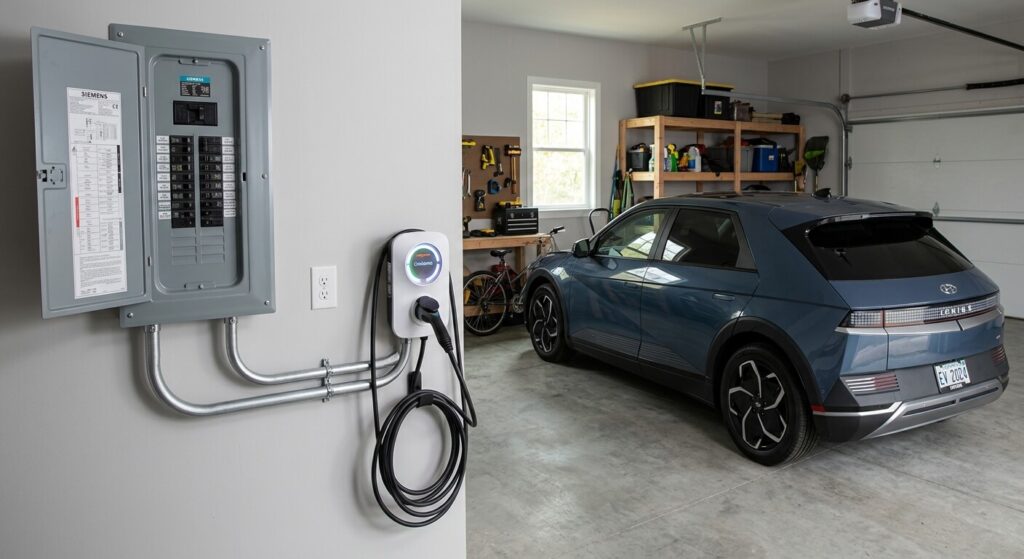
Where your electrical panel is located, how far the charger needs to be from it, whether your existing electrical service can support the installation, and whether the wiring has to cross finished areas can all change the final price.
So before shopping for a charger, it helps to understand what you’re actually paying for.
At a Glance
| Installation Type | Typical Cost |
|---|---|
| Basic | $700–$1,200 |
| Standard | $1,200–$2,500 |
| Complex | $2,500–$7,000+ |
These are planning ranges, not quotes. A simple installation with the electrical panel close to the garage can be much easier than one involving a detached garage, long wiring runs, or electrical upgrades.
A reasonable starting budget for a typical installation is around $1,700, but your actual project can land well above or below that depending on the home.
What Are You Actually Paying For?
Buying a Level 2 charger is only part of the project.
Your total cost can include:
- The charger itself
- Electrical wiring and conduit
- Labor
- A new circuit
- Permits and inspections
- Additional work required by the location
- Potential electrical upgrades
The charger may cost a few hundred dollars, but the installation is where the big price differences usually appear.
That’s why two homeowners can buy similar chargers and end up with very different installation bills.
What Makes Installation More Expensive?
1. Distance From the Electrical Panel
This is one of the simplest things to understand.
If your electrical panel is close to where you want the charger, the installation can be relatively straightforward.
If the charger is on the other side of the house, the installer may need to route wiring through walls, ceilings, attics, or other finished areas.
Longer and more complicated routes generally mean more labor and materials.
The shorter and simpler the path, the better.
2. Your Electrical Service
Your existing electrical system matters.
Some homes may have plenty of capacity for a Level 2 charger.
Others may require additional work before the charger can be installed.
You don’t need to determine this yourself.
Have a qualified electrician evaluate the existing electrical service before assuming your installation will be simple.
If an electrical upgrade is necessary, that can move a project from the standard price range into the several thousand dollar range.
3. Detached Garages and Long Runs
A detached garage can make an otherwise simple installation considerably more complicated.
The wiring may need to travel underground or across a larger distance to reach the charging location.
Trenching and other site work can add hundreds or thousands of dollars depending on the property and how the wiring needs to be routed.
If your charger isn’t going next to the house’s existing electrical infrastructure, get a quote before buying the equipment.
Do You Need the Most Powerful Charger?
Probably not.
This is one place where EV buyers can get caught up in specifications that may not matter much to their daily life.
A faster Level 2 charger can be useful.
But the right question is:
How much charging do I actually need overnight?
If your EV is normally parked for several hours every night, you may not benefit much from paying extra for the highest charging speed your home can support.
On the other hand, someone who drives a lot and regularly needs to add substantial range overnight may value faster charging more.
Buy the charging speed that fits your routine not the biggest number on the box.
Hardwired or Plug-In?
There are two common approaches you’ll encounter:
Hardwired
The charger is permanently connected to the home’s electrical system.
Plug-In
The charger connects to a dedicated outlet.
Both approaches exist for residential charging, and which makes sense depends on the equipment, installation, and your home.
Rather than deciding based on an internet recommendation, ask your electrician:
Which installation would you recommend for my situation, and why?
That’s a much better question than assuming one method is always better.
What About a Panel Upgrade?
This is where an installation can become expensive.
If your existing electrical service doesn’t have enough capacity for the charging setup you want, an electrician may recommend additional electrical work.
That doesn’t automatically mean you need to spend thousands upgrading everything.
Depending on the situation, there may be other approaches worth discussing, including energy management systems that control EV charging based on the home’s other electrical demand.
The important part is:
Don’t assume the answer is either “install the charger” or “replace the whole electrical service.”
Ask the electrician what options are available and what each one would cost.
Don’t Forget the Smaller Costs
The charger installation quote isn’t necessarily the only expense.
Depending on your location and installation, you may also encounter:
- Permit fees
- Inspection-related costs
- Drywall repair
- Painting or finish work
- Trenching
- Additional weatherproofing for outdoor installations
These aren’t necessarily required for every project.
That’s why an itemized quote is so useful.
You want to know exactly what you’re paying for before work begins.
How Much Should You Budget?
A simple way to think about it:
– Basic Installation
$700–$1,200
Think: electrical panel nearby, short wiring run, straightforward installation.
– Standard Installation
$1,200–$2,500
Think: longer wiring route, more complicated access, or some additional electrical work.
– Complex Installation
$2,500–$7,000+
Think: significant electrical work, difficult routing, trenching, or other major complications.
The exact dividing line isn’t universal.
Your home determines the difficulty.
Before You Buy a Charger
You don’t need to know electrical engineering to get a better installation quote.
You just need to ask better questions.
Ask the electrician:
1. Can my existing electrical service support the charger I want?
2. Where would you install it?
3. How will the wiring get from the panel to the charger?
4. Would you recommend hardwired or plug-in for this installation?
5. Are there any additional electrical upgrades you expect?
6. Are permits and inspections included in the quote?
7. Is any drywall repair, trenching, or other site work included?
8. What could cause the final price to increase?
Those questions can tell you much more than simply asking:
“How much does a Level 2 charger installation cost?”
Get More Than One Quote
For a project that could potentially cost several thousand dollars, getting multiple quotes is worth the effort.
Aim for two or three itemized quotes.
Don’t compare only the final number.
Compare:
- Labor
- Materials
- Charger
- Electrical work
- Permit costs
- Additional work
- What is and isn’t included
A $1,200 quote isn’t necessarily cheaper than a $1,500 quote if the first one leaves important work out.
Compare what you’re buying, not just the bottom line.
Is a Level 2 Charger Worth It?
For many EV owners, the biggest benefit isn’t necessarily charging faster during the day.
It’s waking up with enough charge for the next day’s driving.
Level 2 charging can make home charging substantially more convenient than relying on a standard household outlet.
But that convenience has a cost.
If your current Level 1 charging already covers your daily driving, spending thousands of dollars on a Level 2 installation may not be necessary.
If you’re regularly struggling to add enough range overnight, the calculation changes.
Who Should Consider It?
Buy
A Level 2 installation makes sense if:
- You drive enough that Level 1 charging isn’t keeping up.
- You have a convenient place to install the charger.
- The installation cost fits your budget.
- You plan to keep the EV long enough to benefit from the convenience.
Depends
It’s worth thinking about if:
- Your Level 1 charging is almost enough.
- You don’t drive very much.
- The installation requires significant additional electrical work.
- You’re unsure how long you’ll keep the vehicle.
Skip for Now
You may not need Level 2 yet if:
- Your daily driving is easily covered by Level 1 charging.
- You have convenient workplace or public charging.
- The installation would require expensive work that doesn’t provide much additional value for your driving habits.
Living With It
The best home charger installation isn’t necessarily the fastest or most expensive one.
It’s the one that makes charging easy without spending thousands of dollars on capability you don’t actually need.
For most buyers, the decision comes down to three things:
How much do you drive?
How quickly do you need to recharge?
How difficult is your house to wire?
Get those three answers first.
Then choose the charger.
Grounded Verdict
Depends.
A Level 2 charger can make EV ownership considerably more convenient, but installation costs can vary dramatically from one home to another.
A straightforward installation might be around $700–$1,200.
A more typical or complicated installation can move into the $1,200–$2,500 range, while difficult projects involving major electrical work, trenching, or other complications can reach $2,500–$7,000+.
The mistake is buying a charger first and figuring out the installation afterward.
Get the electrical situation evaluated, get itemized quotes, and choose the charging setup that matches how you actually use your EV.
You don’t need the most powerful charger.
You need the one that makes sense for your home, your driving, and your budget.