Can You Own an EV Without Home Charging?
A Grounded Guide to Public Charging, Apartment Living, and Real-World EV Ownership
Grounded Question
Can you realistically own an EV without charging at home—and more importantly, should you?
At a Glance
| Your Situation | Recommendation |
|---|---|
| Reliable charging at work | 🟢 EV is very doable |
| Public charger near home or daily routine | 🟢 EV is doable |
| Regular access to fast charging | 🟡 Depends on your habits |
| Charging requires frequent detours | 🟠 Proceed carefully |
| No reliable charging routine | 🔴 Consider a hybrid instead |
Short Answer
Yes, you can own an EV without home charging.
Whether you should is a different question.
The best EV owners without home charging typically have a routine. They charge at work, at a nearby public charger, or during activities they’re already doing.
The worst experiences usually happen when charging becomes an extra chore.
The question isn’t whether charging exists near you.
It’s whether charging fits naturally into your life.
Why This Matters
One of the biggest misconceptions about EV ownership is that everyone needs a garage with a Level 2 charger.
While home charging is convenient, millions of people live in apartments, condos, or homes without dedicated parking.
For those buyers, the decision isn’t:
Can I buy an EV?
It’s:
Will charging become a constant inconvenience?
That’s a much more important question.
The Difference Between Possible and Practical
Many EV advocates focus on whether charging is available.
That’s only half the story.
Imagine there are public chargers five miles away.
Technically, you can charge.
But if every charging session requires:
- A 15-minute drive
- Waiting for an available charger
- Sitting for 30–45 minutes
- Driving back home
That’s very different from plugging in overnight.
The true cost isn’t just electricity.
It’s convenience.
Your Charging Options
Workplace Charging
For many people, this is the next best thing to home charging.
If your employer provides reliable charging, an EV can be surprisingly easy to own.
You arrive with a partially depleted battery and leave with a full one.
No special trips required.
Public Level 2 Charging
These chargers are commonly found at:
- Shopping centers
- Parking garages
- Apartments
- Hotels
- Grocery stores
They’re often most useful when charging can happen while you’re already doing something else.
DC Fast Charging
Fast chargers are excellent for road trips and occasional top-ups.
However, relying on them as your primary charging solution can become expensive and time-consuming.
They’re best used as a supplement, not a daily habit.
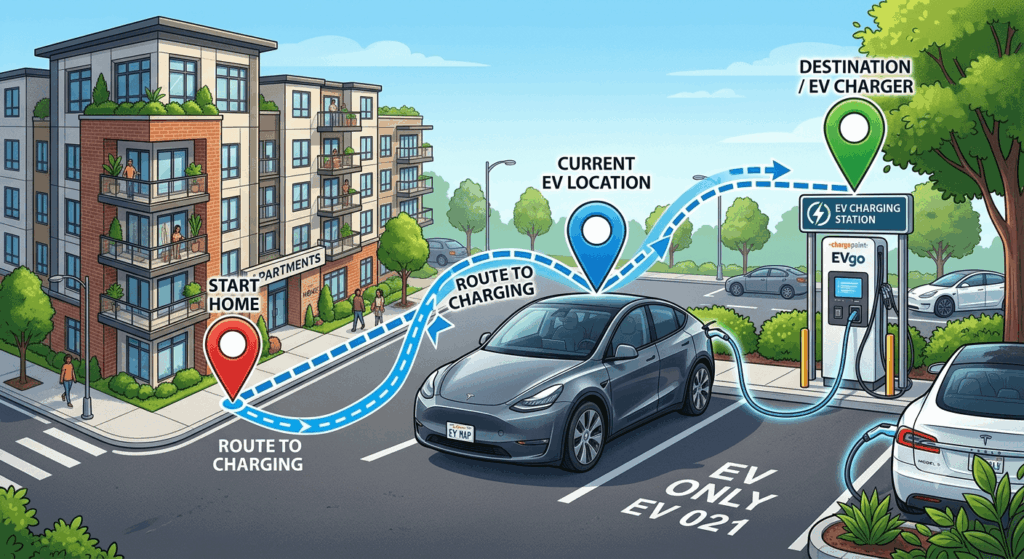
Apartment Charging
Apartment charging is improving rapidly.
Some communities now offer:
- Reserved EV spaces
- Shared charging stations
- Charging included with rent
Others offer nothing at all.
Before buying an EV, investigate your property’s current charging options—not future promises.
How Much Do You Actually Drive?
This question matters more than battery size.
If you drive 20–40 miles per day
You may only need to charge once or twice per week.
Public charging can be much easier to manage.
If you drive 80–100+ miles per day
You’ll likely charge more often.
Without a convenient charging solution, ownership can become frustrating quickly.
Don’t buy based on your longest trip.
Buy based on your average week.
The Convenience Test
Before buying an EV without home charging, ask yourself:
Is charging already on a route I take?
Good.
Can I charge while working, shopping, or exercising?
Even better.
Do I need a special trip just to charge?
That’s where problems start.
What happens if my preferred charger is occupied or offline?
Always have a backup plan.
The more effort charging requires, the less enjoyable ownership becomes.
What Does It Actually Cost?
Many buyers focus only on electricity costs.
But public charging ownership should consider:
- Electricity rates
- Charging network fees
- Travel to and from chargers
- Time spent charging
- Opportunity cost
A charger that’s slightly more expensive but conveniently located is often the better choice.
Convenience has value.
When an EV Makes Sense Without Home Charging
An EV can work very well if:
- You have workplace charging.
- Public chargers are close and reliable.
- You drive predictable distances.
- You don’t mind occasional planning.
- You have multiple charging options available.
Many owners successfully operate this way every day.
When You Should Probably Consider a Hybrid
A hybrid may be the better choice if:
- You have no consistent charging solution.
- You move frequently.
- You rely heavily on street parking.
- Public chargers are unreliable in your area.
- You don’t want charging to require planning.
A hybrid won’t eliminate fuel costs, but it may eliminate a lot of frustration.
Before You Buy
Ask yourself:
- Where will I charge most often?
- How far away is that charger?
- How often will I need to charge?
- What happens if it’s unavailable?
- Am I willing to build charging into my routine?
If you don’t have good answers to those questions, keep researching before committing.
What’s the Catch?
Many EV owners without home charging are perfectly happy.
Many others eventually realize they underestimated the inconvenience.
The difference is rarely the vehicle.
It’s the charging routine.
The better your charging plan, the better your ownership experience.
Living With It
After a few months, most EV owners settle into habits.
The goal is to make charging feel like something that happens in the background—not a task that dominates your schedule.
The closer you get to that experience, the more likely you’ll enjoy EV ownership.
Grounded Verdict
Depends.
You can absolutely own an EV without home charging.
You should if you have a reliable charging routine that fits naturally into your life.
You probably shouldn’t if charging requires regular detours, long waits, or constant planning.
The question isn’t whether an EV can survive without home charging.
It’s whether you want charging to become part of your routine.
Related Tools
Related Guides
- EV vs. Hybrid: Which Should You Actually Buy?
- Are EVs Really More Expensive to Insure?
- Can You Actually Buy a Good EV for Under $20,000?
References
This guide incorporates current EV charging realities, public charging use cases, apartment living considerations, workplace charging scenarios, and ownership convenience factors to help buyers determine whether an EV fits their specific lifestyle.